At the age of seven, Guillermo del Toro watched the 1931 film based on Mary Shelley´s classic 1818 novel, Frankenstein, and since then, his future has been decided; he had to recreate his own version of Frankenstein.
At the time of the book’s publication, gothic romance was a staple in society’s reading interests. Because the novel was written by a teenage girl, the constant questions of: ‘Why am I human?’ and ‘Why am I here?’ are extremely important to its structure, and fueled part of Guillermo del Toro’s ‘want’ to create his own version. Along with those questions was the undeniable connection del Toro felt between himself and The Creature, stating, “We are all creatures. I mean, we have a world that tells you ‘you shouldn’t be a creature,’ but in reality, we’re all weird in some way. And it’s not the weird that is bad, it’s the fact that we say that the weird is bad.” He saw the torment and pain behind his eyes and saw, in a way, himself, especially with how it takes time to learn how to construct things, such as filmmaking, in a beautiful way. Since reading the book and watching the original films, del Toro has captured the story of Frankenstein in all of his films.
Del Toro’s 2025 film interpretation of Mary Shelley’s Frankenstein is something entirely different from what has been done in the past. In interviews, del Toro stated how he wanted to show the true nature of The Creature and portray him as he was in the story. He wanted to show the process of Victor Frankenstein’s attempt at creating life, creating The Creature, Adam, as something more than just a gory and grotesque experiment. Del Toro stated he wanted to include every bone, muscle, ligament, and tendon in the creation process. The prosthetic mannequin(s) lived up to that. Adam’s creation wasn’t the only thing that del Toro wanted to change.
In past adaptations, The Creature’s structure and features changed completely from how Shelley wrote him. Movies portray him with a square head, green skin, and bolts in his neck, but del Toro wanted to keep true to the story by giving him a “human” look. The Creature’s looks are almost completely accurate to Shelley’s description of him, with a few exceptions, such as more scars littering his body. However, the abundance of scars is more realistic considering that his creation was pieced together piece by piece, fragment by fragment.
Jacob Elordi’s movements were child-like yet had almost an animalistic feel, especially in the beginning of the film. His speech resembles that of a child first learning how to talk. Even near the end of the movie, Elordi’s dialect is still fractured and fragmented, showing how The Creature is still learning but becoming more human. This is truly the first instance in which The Creature felt like Mary Shelley’s creature.
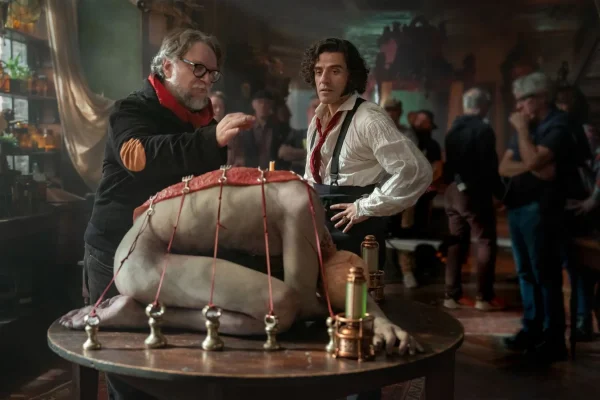
Oscar Isaac’s performance as Victor gave off a feeling of a man gone mad, a man descending into a land of no return, especially during the formation of his idea to create life from death. His movements felt true to an actual surgeon, but the way he presented himself to the public and to his family felt almost deranged. Isaac truly embodied Victor Frankenstein and gave one of the best performances of his already phenomenal career.
Del Toro specifically made the beginning and the end of the movie with limited colors: blue, white, and gold. With the second section of the film being based on Victor’s childhood, del Toro wanted to show the colors that Victor imagined his childhood had, with black, white, and red. His mother is the only one seen wearing red in the beginning, and after her death, the red continues only with Victor. The blood from his mother was the main factor in his fascination with conquering death, and the blood from The Creature resembles a connection between the characters. The use of green is connected to Elizabeth, the love interest of Victor’s brother, William, whom Victor eventually falls for, stating that once he met her, he became more interested in life than death, and pertains to the batteries used to give The Creature life. Both Victor and The Creature, however, are connected in death, and of course, Victor’s newfound interest in life. Golden hues are used for The Creature and his story, which places it in more of a “pastoral fairy tale,” as quoted by del Toro himself.
Colors weren’t the only major symbolism in the movie. Del Toro managed, in a way, to infuse faith and religion seamlessly into the film. He uses the brothers, Victor and William, as a small symbol of Cain and Abel. Del Toro states that he had pieces he wanted to capture with Catholicism, one being forming allegorical parallels of God creating Jesus, and how God sent his son to experience pain and death. He portrayed The Creature as a sort of messiah to atone for the sins of his creator. And in the end, the use of Victor asking Adam to say his name as he used to in the beginning of his life is a very full circle moment. Adam realized that Victor’s apology and his forgiveness were able to set them both free from a life of torment, atoning for his creator’s sins, and in return, forgiveness for a life unwanted. Once The Creature said his name and forgave him, only then was Victor able to die, and The Creature truly lived. Again, the portrayal of God and Jesus is presented in Victor and his father. The painful story of an abusive father-son relationship between the two connected later on with Adam and Victor. A never-ending cycle.
Fire is a persistent symbol with both Victor and Adam, but it is used in different ways. For Victor, fire is used as something evil, something that follows him to his grave and haunts him. Its first appearance was with the archangel in his dreams, then again when he lit the tower on fire, both standing as a symbol of his downfall. In that scene, the fire showed Victor’s true nature. As Adam called out for him, we see Victor have a realization that he himself is acting cruelly towards his creation, towards his son. Victor’s decision to turn back and save The Creature from the fire shows that he had the potential to change. That moment is the only time we see him with actual humanity, but he never reaches it because of his own damning decisions. The Creature’s connection with fire is softer. Fire is what freed him from imprisonment, it gave him warmth, and transformed him, and eventually it gave him an equal footing to his creator. For Adam, fire was just nature, and nature was revelation.
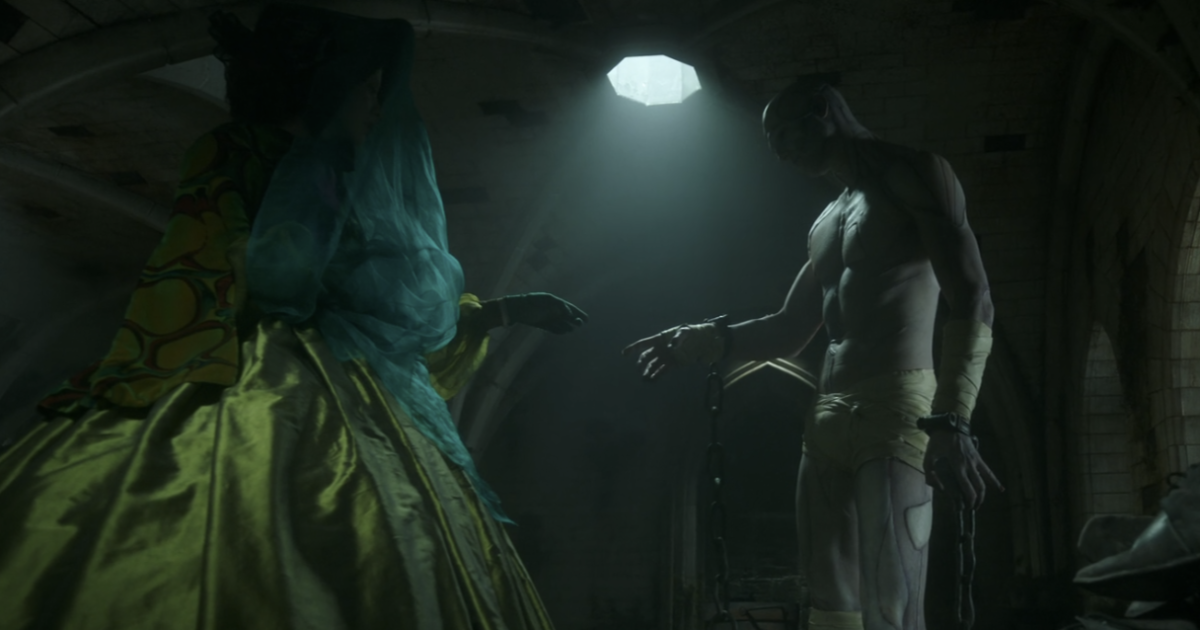
In the movie, del Toro managed to capture important historical paintings in many of the scenes. One that seems to be the most important is in the scene where Elizabeth First meets The Creature. Both characters reach out for each other’s hands, and for a brief moment, they recreate “The Creation of Adam” by Michelangelo.
Like all book-to-film adaptations, things can stray from the original design and story. Del Toro did make changes to the film; however, they worked in his favor. In the original text, Victor Frankenstein’s father was loving and caring, but in the film, del Toro wrote him as cruel and unforgiving, someone to be feared. His rendition of Alphonse Frankenstein and the hidden story of him practically murdering his wife helped grow Victor’s story and his eventual idea of conquering death. His defiance of his father was still connected to changing the laws on death, but the film made it so his ideas were to topple his father’s beliefs on life.
Another instance is his changes to Elizabeth’s and The Creature’s relationship. In the book, Elizabeth and Adam only encounter each other once, but in the movie, Elizabeth plays a larger role in forming The Creature into a gentle soul. It was Elizabeth’s maternal instincts and her kindness that helped Adam along his journey. She was a partial factor in his want for a companion, someone like him to have a life with. While this story is different from the book, it was very fitting and interesting to see the dynamic play out.
Guillermo del Toro’s rendition of Frankenstein is truly a masterpiece and most definitely the film of the season.