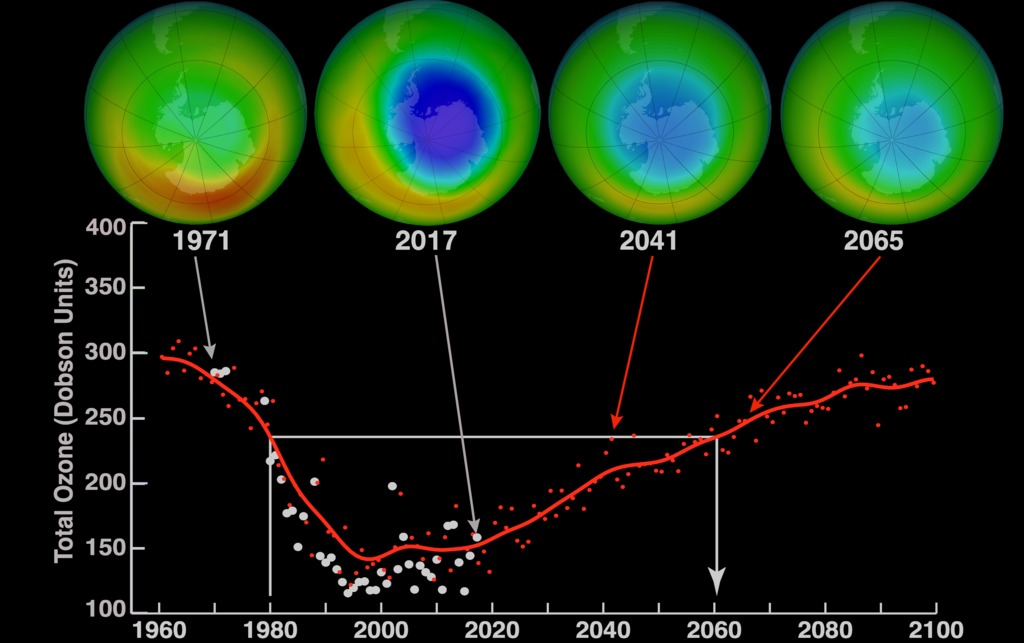
Since 1987, scientists have monitored the ozone layer due to chlorofluorocarbons and hydrochlorofluorocarbons, or CFCs and HCFCs, slowly causing the ozone layer to deteriorate, signing the “Montreal Protocol” initiative to help reduce harmful chemical leakage into the atmosphere. In the 1970s, scientists weren’t even positive that CFCs and HCFCs were the issue, just an estimated guess after observations on the Antarctic. The British Antarctic Survey later concluded that the ozone levels in the atmosphere above the Antarctic were rapidly dropping during spring in the southern hemisphere. NASA used the information from the paper to analyze and map out images from their Total Ozone Mapping Spectrometer that confirmed the depleting ozone levels, and found that, over time, the decrease had created the “ozone hole” roughly the size of the whole continent of Antarctica.
You may be thinking: What does any of this mean? Well, ozone is a chemical compound composed of three oxygen atoms that is found about 8-30 miles above Earth’s surface. The ozone layer protects life on Earth by absorbing harmful ultraviolet (UV) radiation reflecting off the Sun. Ozone essentially works as a shield that prevents crops from dying and humans from extreme heat stroke and skin cancer. NASA’s Earth Sciences chief scientist, Paul Mewman, stated: “If there were no ozone layer, the Sun would sterilize Earth’s surface.”
CFCs are chemicals found on everyday objects. Things like refrigerants, air conditioners, and car cooling systems use CFC-12 to keep the cool contained; aerosol propellants such as deodorant hold CFCs; and foaming agents use CFC for plastic foam in fire extinguishing and packaging due to its non-flammable nature. It’s nearly impossible to escape the use of CFCs. The problem isn’t on the surface, but rather in the stratosphere. When CFCs are eliminated or leak out, the “emissions start in the troposphere and work their way up to the stratosphere,” according to Susan Strahan, a scientist at NASA. UV radiation breaks down the bonded chemicals trapped above the ozone layer, creating highly reactive chlorine atoms, which then react with other chemicals, forming new hydrochloric acid and chlorine nitrate. Both reservoir gases, hydrochloric acid and chlorine nitrate, react with the surfaces of thin cloud particles in the Antarctic winter, trapping the chemicals, but once spring hits and the Sun returns, UV radiation causes the gases to destroy the ozone layer. According to NASA, “one chlorine atom can destroy thousands of ozone molecules,” and from the 1920s through the early 1990s, millions of CFCs have been filtered into the atmosphere, with the “Antarctic polar region [bearing] the brunt of the damage.”
In 2020, 33 years after initial discovery, scientists found that the hole within the ozone layer is finally showing signs of recovery. Anna Douglass and Susan Strahan published a paper two years prior, in 2018, confirming chlorine levels in the atmosphere have fallen, providing evidence for the effectiveness of the Montreal Protocol, with Strahan saying, “If you don’t know how much ozone is up there, you don’t know if it’s getting better or worse. If it does change, was it natural variability or was it caused by humans?” The research even showed a possibility of the ozone layer completely healing by 2066.
After the Montreal Protocol proved effective, countries around the world began implementing green initiatives. Companies use recycled and recyclable packaging, electric cars became popular, but most importantly, due to the steps taken, chemical emissions have lowered. However, this astonishing recovery has now been delayed. Monitoring tracks have shown that leakage rates are rising. Massachusetts Institute of Technology scientists have conducted research that chemicals depleting the ozone layer “can still be used as feedstocks to produce other materials, based on the belief that only a tiny fraction, about .5 percent, would escape into the atmosphere.” Feedstocks are raw materials that are changed into a final product, but in order to reach that final product, it takes a factory.
Scientists have estimated that the leakage from feedstock is significantly large, reaching a level of almost 3.6 percent. Due to this recent discovery, the healing process is estimated to take seven additional years than previously predicted, with the ozone layer healing by 2073 rather than 2066. An analysis research set 3.6 percent as a baseline and ran through different scenarios in which production data was reviewed from 2014 to 2024, and which chemicals were used as feedstocks through 2100. Overall emissions in the scenarios continued to leak at current levels, stabilizing at 2045, yet still only declining by 1.8 percent of the overall 3.6 percent. Stefan Reimann, a researcher for the paper, stated, “emissions are too high, and we have to find a way to reduce them. Either that means no longer using these substances as feedstocks, swapping out chemicals, or reducing the leakage emissions when they are used.”
In light of recent political events within several countries, larger companies are also now finding ways to bypass the green laws, taking them as a suggestion or a trend that will soon bubble over. Higher pollution is now occurring, furthering global warming, capsizing, and damaging the atmosphere because companies don’t care about destroying Earth. A 2024 Nature study conducted via satellite found higher methane emissions in the U.S., and later found that 2025 holds the highest record for fossil fuel pollution. The International Energy Agency released a statement saying “total methane emissions from oil, gas, and coal production remain at about 124 million tonnes per year,” roughly equivalent to three billion cars’ worth of emissions.
Even though CFCs are being reduced, there are still chemicals spilling out into oceans, rivers, lakes, forests, literally every surface on the Earth, that are still contributing to the high temperature, strong air pollution, and the continuing depletion of the ozone layer. It’s important that we act fast to help speed up the ozone recovery process once again and prevent further pollution. We only have one planet, and it’s our job to protect it.