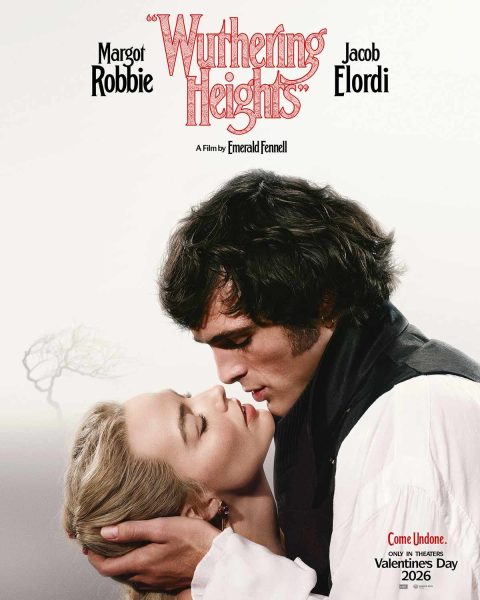
Since the release of Emily Brontë’s gothic novel Wuthering Heights in 1801, society has taken it as a dark and twisted love tale. The story does hold a romantic aspect to it with more obsession and greed than any other form, but the story also holds revenge, domestic cruelty, and social status and class as other primary themes. Previous adaptations and discussions have shown just how deeply people believe it’s only a love tale, one similar to Romeo and Juliet, or other sappy romances, which couldn’t be further from the truth. So, it’s no surprise that director Emerald Fennell encapsulated that idea in her new film based on the book, titled Wuthering Heights.
Brontë’s book depicts a sort of sick, demented, and obsessive love that eventually turns into something that needs to be feared. Set in Northern England, the book opens in the present moment, with a man named Mr. Lockwood entering a farmhouse, visiting the landlord, Heathcliff. The novel then goes on to describe how Mr. Lockwood is essentially losing his mind while reading diary entries, hearing the voice of a woman practically begging to enter through the window. Throughout the chapters, the timeline shifts, going back 30 years and visiting the previous owners of the farmhouse, the Earnshaws. It focuses on the relationship of Catherine Earnshaw and Heathcliff, a boy who was brought home by Cathy’s father, presumably due to how poorly he was living. Later on, they receive new neighbors, Edgar Linton and his sister Isabella. Cathy sparks a fleeting love with Edgar, but admits to her servant Nelly that she truly has feelings for Heathcliff. Everything unravels, many die from illness, and some become controlling and abusive. Emerald Fennell’s version falls short on all fronts for the most part. Fennell seemed almost intimidated by how complex it was, stating that the novel was indeed complex and nearly impossible for anyone to make. While Fennel does keep the storyline of Cathy and Heathcliff’s obsession towards one another, she changes it in a way to appeal to booktok fans and deeply deprived romance lovers who’ve never read or heard of the book.
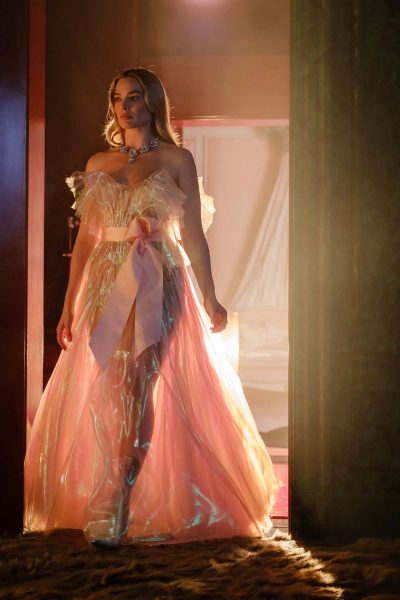
Fennell’s take on the novel feels something akin to Alice in Wonderland by Lewis Carroll or a Conan Gray concert, with how eccentric and bright the costumes were, rather than a period piece. The movie felt almost staged, like a feverish nightmare. Admittedly, yes, the costumes are quite beautiful, and the attention to detail and theme is concise throughout the entirety of the film, yet it does not hold the same meaning as period-accurate clothing. It’s more of a show of what could be, not what was.
The dialogue sounded almost like artificial intelligence wrote it with the assistance of a person, with how choppy the sentence structures were, meaning that the character’s dialogue in the same areas of the movie seemed to be separate rather than a conversation, though somehow, Fennell stated that she “used much of Brontë’s original written words.” She said, “I was really determined to preserve as much of her dialogue [as possible] because her dialogue is the best dialogue ever, I couldn’t have done it better, and who could?,” but somehow, she still managed to take Brontë’s incredible and beautiful written work and turn it into something dry and stiff.
Part of the novel’s plot is based on racial discrimination towards the main character, yet Fennel found a way to completely avoid the subject. Instead of casting a person of color for the role of Heathcliff, Fennell went with Jacob Elordi, an Australian actor known for his roles in Fennell’s previous film Saltburn, Sofia Coppola’s Priscilla, and Guillermo del Toro’s Frankenstein. Since the announcement of Elordi’s role in the film back in late 2025, fans of the novel have been spewing anger towards Fennell for “whitewashing the role.” Though scholars state that Heathcliff’s race remains up to interpretation, they do acknowledge that he is described as having “dark” skin and having vague comments on him presumably being South Asian. Additionally, after the introduction of Cathy’s soon-to-be husband, Edgar Linton, Heathcliff says, “I wish I had lighter hair and fair skin,” and the servant Nelly Dean continues with how he could be a “prince in disguise,” and “who knows but your father was emperor of China, and your mother an Indian queen.”
What’s rather disturbing about this adaptation is that Fennell herself stated in an interview that ‘Wuthering Heights’ was going to consist heavily of parts she herself remembered from the novel and things that she wished could have, or things she thought should have, happened. In the novel, one of the characters, Isabella, faces heavy abuse from Heathcliff, yet in the movie, Fennell portrays it as something to be enjoyed, completely disregarding Isabella’s true feelings and reactions towards Heathcliff. Fennel played it off as some sort of sexual pleasure rather than the torture and pain it actually was. It seemed almost as if Fennell was imposing herself on Isabella, turning her character, and practically the entire film, into a self-insert fan fiction.
Yes, this movie may have been visually appealing, but it really was nothing like how Emily Brontë wrote it.