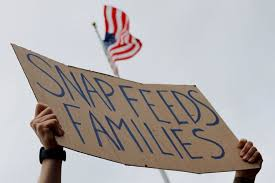
Due to the government shutdown that began on October 1, 2025, the SNAP (Supplemental Nutrition Assistance Program, commonly known as food stamps) benefits for millions of Americans are in danger. There has been debate on whether they would be paid or if millions of Americans would go hungry, and now, due to a judge’s ruling on November 3, the Trump administration will have to use the contingency plan to pay for and restart SNAP benefits. Though this is a good thing, it has been confirmed that they will only partially pay for SNAP benefits.
SNAP benefits are extremely important. About 42 million Americans rely on SNAP benefits to survive. SNAP can help families in many different ways, whether through monthly food assistance, special programs like D-SNAP, discounts on utilities, or the Restaurant Meals Program. SNAP is crucial for low-income families and makes a big difference in their economic well-being and health, but it is also good for local communities. Each dollar in federally funded SNAP benefits generates $1.79 in economic activity. In fact, the Food Research and Action Center states, “SNAP lifted 4.6 million people out of poverty in 2015.”
The Supplemental Nutrition Assistance Program began as a permanent program in 1964 after President Lyndon B. Johnson signed the Food Stamp Act. This program was first tested on a small scale during and after the Great Depression to help assist farmers and the unemployed, and was attempted again under President John F. Kennedy. Back then, these were primarily distributed as a physical coupon that the recipients would purchase and then use to buy food. Today, SNAP is a direct-assistance program and no longer a hybrid program that forced people to purchase food stamps and used bonus stamps to buy only surplus commodities.
SNAP benefits were initially scheduled to go out on November 1, 2025, but the USDA posted that the “well has run dry,” and now they are delayed due to the government shutdown. The judge has ordered the administration to pay a partial SNAP payment by the end of the day on November 3, and a full payment by Wednesday, November 5. Eligible households will receive 50% of their benefits this month, but delays are expected. Taylor Grant, a mother of four who was previously homeless, stated to Tampa Bay 10, “It’s very disheartening to hear people looking down on others and making fun of them for the cuts that are happening because it could be you in a blink of an eye,” Grant said. “Just have a heart.”
There are some states that are providing their own funding to help their residents amid the pause of SNAP benefits. New York has provided $40 million for emergency food and $25 million to support book banks, according to ABC News. Maryland has put $62 million towards SNAP as the shutdown continues. California, Louisiana, and New Mexico are announcing their plans to help alleviate the pain of losing SNAP benefits, and multiple states are having restaurants and food banks offer free or heavily discounted meals.
Although the expected date has passed, court systems and individual states are working to bring back these benefits during this ongoing situation.