
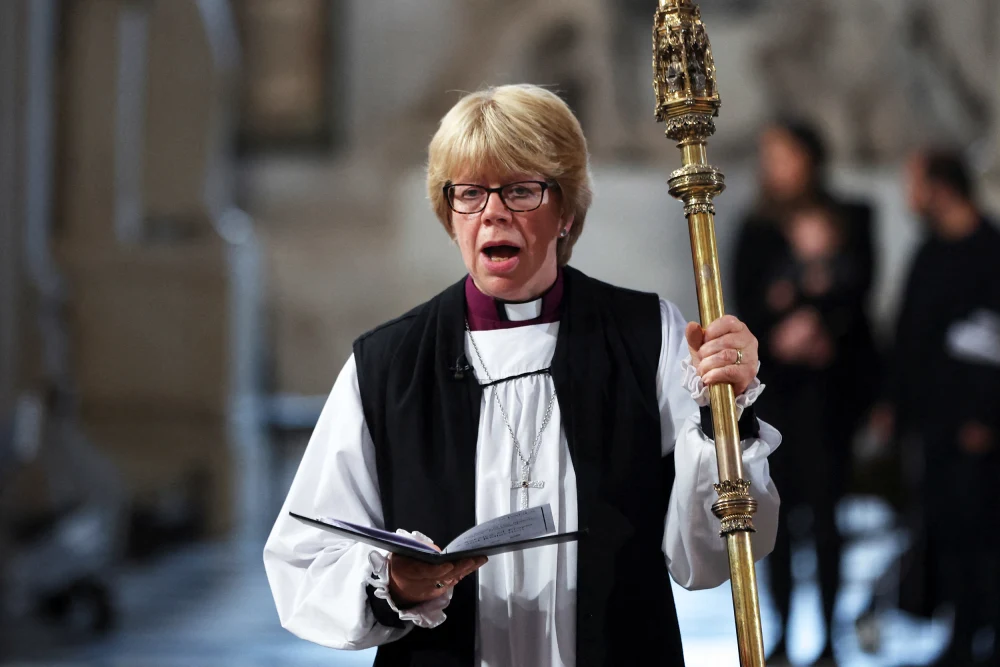
In October 2025, Sarah Mullally was named the Church of England’s top leader. Beginning on March 25, 2026, Mullally will be the new Archbishop of Canterbury, leading the world’s 85 million Anglicans.
Mullally will succeed former Archbishop of Canterbury Justin Welby, who stepped down in January after being accused of inappropriately addressing child abuse allegations by a British lawyer on young victims he met at youth camps, according to Episcopal News Service.
The Archbishop of Canterbury is the senior bishop and a spiritual leader of the Church of England and the worldwide Anglican Communion. They serve as the chief administrator and spiritual leader of their own district, under the pastoral care of a bishop in the Christian Church, which is referred to as an archdiocese. The archbishop supports diverse interests and causes within the Church of England, the worldwide Anglican Communion, and secular and civic life.
Mullally has served as the bishop of London since 2018. and is the first woman to hold this office. She is also a Lord Spiritual, one of the 26 Church of England bishops who sit in the House of Lords of the Parliament of the United Kingdom. She was ordained to the priesthood in 2001 after a career as a nurse treating cancer patients. Mullaly was the youngest person ever appointed as the chief nursing officer for England.
Presiding Bishop of the Episcopal Church in the U.S. Sean Rowe congratulated Mullaly on her historical achievement in a statement, “Bishop Sarah is known in the Church of England as a wise and steady leader, a faithful advocate for the leadership of women in the church, and a bishop who will be committed to safeguarding vulnerable people and victims of abuse.”
Christianity has a long history of excluding women from leadership roles, the reasoning often cherry-picked directly from the Bible, one example being in Timothy 1:11-12, when the Apostle Paul instructs: “ A woman should learn in quietness and full submission. I do not permit a woman to teach or to assume authority over a man; she must be quiet.” This is one of many instances in the Bible that restrict women’s power in the Church. However, this doesn’t change the fact that this is not just an unfair law, but that this verse, specifically, has often been taken out of context by the Church to suppress women. When used in an argument to limit the role of women in the Church, it is interpreted as universally wrong for women to preach and hold any form of power or influence over men. However, many scholars interpret this verse as specific to the early church in Ephesus, referring to a particular type of public, authoritative teaching role, rather than all forms of teaching.
The Bible is full of unusual laws that are not meant to stand the test of time; they are often very specific to the time period, put in place with the knowledge of an ever-evolving world. Because of this, the majority of Christians don’t follow every single law—only the substantial ones that define their faith, and also the ones pushed by the institution of the Christian Church. This includes the laws that often reinforce historical power dynamics.
Due to these reasons, it was only very recently that women were able to hold even small positions of power within Christian churches, and many denominations disregard this practice altogether.
Sarah Mullally had history against her, but she still managed to combat centuries of oppression, which is why Mullally’s achievement as the first female Archbishop of the Anglican Church is so groundbreaking.








Jessica • Feb 8, 2026 at 8:38 am
This is an exciting development! I believe that restoring women to positions of leadership in the church (as many were in the early church) will bring healing and hope to an institution meant to be a place of community, safety, and spiritual growth, that has been marred by serious and soul-crushing abuses by men. Women have so much untapped wisdom and have faithfully stewarded the church for millennia.