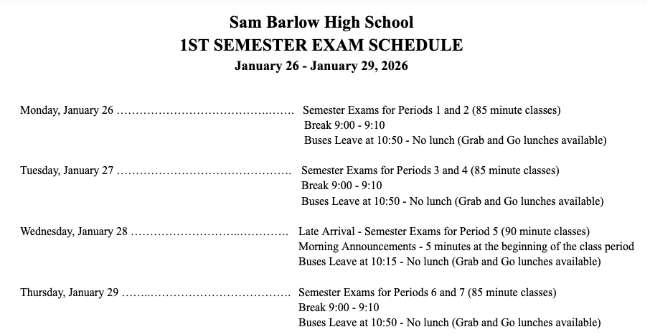
Finals week in high school is a very busy and often stressful time. Barlow’s finals happen at the end of January and the last week of school before summer break in June. During this week, you will take a big test in almost every subject, including all your electives. These tests are important because they could either be a test just on your most recent unit you have been learning, or they can be tests on what you have learned over the whole semester. Because of this, many students feel immense pressure to get good grades and keep their GPA high. You may see students studying or teachers handing out “study guides.” It is very common for students to feel overwhelmed by all the work they have to do in the weeks leading up to finals. They might feel like there aren’t enough hours in a day to finish everything. However, finals are also a sign that the semester is almost over, which means new classes, new teachers, and meeting some new people.
Another plus side of finals is that you only have half days and no school on Friday. On Monday, Tuesday, Thursday, and Friday, you will have two classes. On Wednesday, it will still be a late start, but you will only have one class. Each class is an hour and twenty-five minutes long. Every day, you will have a different set of classes that you will take the final for. For example, on Monday, you will have first and second period, on Tuesday, you will have third and fourth, on Wednesday, you will have fifth, and Thursday you’ll have sixth and seventh. In between your classes, you will have a ten-minute passing time rather than five minutes to give yourself more of a break. Also, instead of having lunch at school, every day before you leave, there will be a grab-and-go lunch for you.
To get ready for your final tests, you should do more than just read your notes or highlight your book. The best way to learn is to test yourself. You can do this by covering up your notes and trying to say the answers out loud, or by writing down everything you remember on a blank piece of paper. Using skills that you may have learned in other classes may help too. “I take AVID-style notes and study them when I get home, and then I will apply them to what I need to learn,” says junior Calub Dixon. It also helps to study a little bit every day instead of trying to learn everything the night before. This makes information stick in your head much better and keeps you from feeling too stressed. Max Moffitt, a junior, says he doesn’t spend large amounts of time studying at once. A good trick to practice this is to set a timer for about twenty to thirty minutes and work without any distractions, like your phone. When the timer goes off, take a five-minute break to walk around or grab a drink. This keeps your mind sharp so you don’t get too tired while you are working. Elsie Wood, a senior, says, “One thing that helps me stay focused while studying is having light music on while I’m working.” Finding something that keeps you focused is key to learning how you study best. You can also try explaining what you have learned to a friend or a family member. If you can explain it in a way that is easy to understand, it means you truly know the material.
Taking care of yourself is just as important as studying your notes. Your brain cannot do its best work if you are tired, hungry, or stressed out. Getting enough sleep is the most important thing you can do during finals week. Many students think staying up all night to study is a good idea, but it actually makes it harder to focus and solve problems during the test. Make sure you are also drinking plenty of water and eating snacks like fruit, nuts, or yogurt. These give you steady energy so you don’t feel a “crash” in the middle of an exam. If you start to feel overwhelmed, take a quick break to walk around, listen to a song, or take some deep breaths. Taking a few minutes to relax isn’t wasting your time; it actually helps your brain reset so you can focus better when you get back to work.