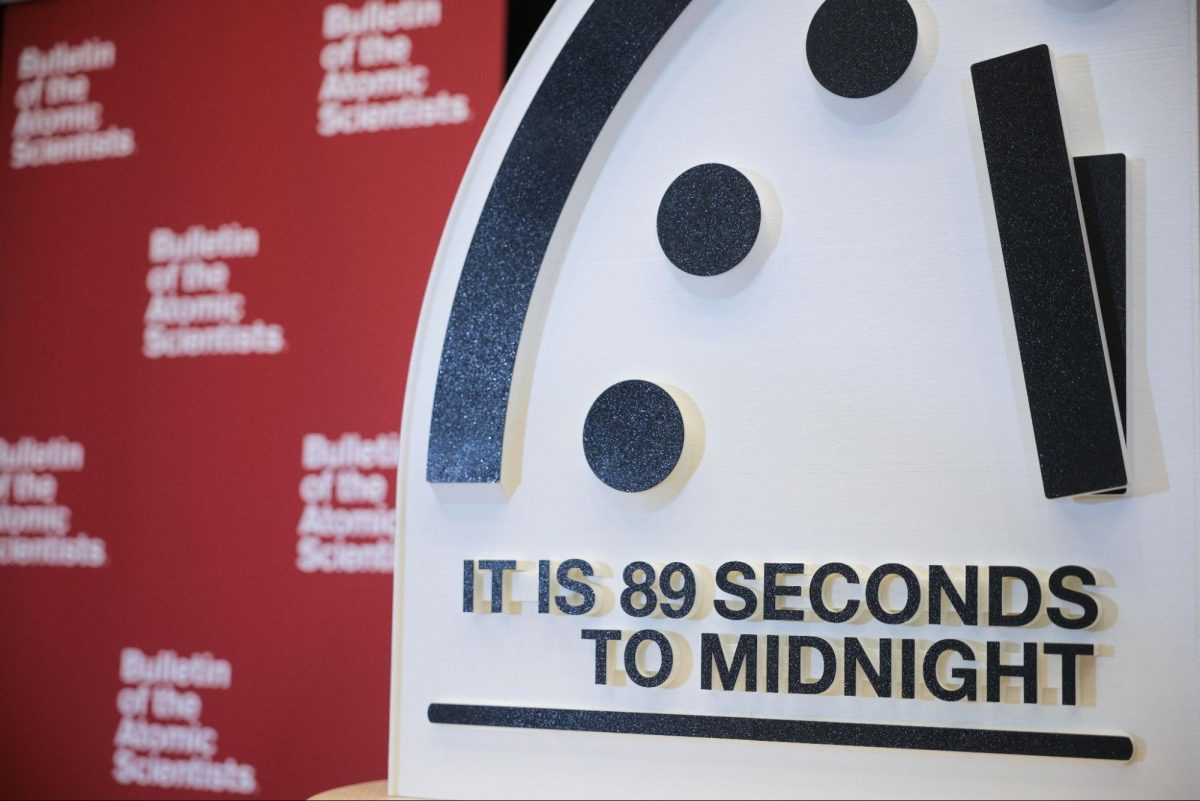
On January 27, the Doomsday Clock was at its closest point to midnight: 85 seconds to midnight.
The Doomsday clock is a visual representation of how close humanity is to self-destruction from human-made threats like nuclear war, climate change, and disruptive technologies like artificial intelligence, with midnight symbolizing global catastrophe. It serves the public as a warning to acknowledge the things that are happening, and a call to action, urging leaders and us to take action and move the clock further from midnight.
Some of the main reasons the Clock was at its closest point ever to midnight on January 27 were nuclear war threats, disruptive technologies, and climate change. According to the Clock, our Earth is close to destruction because of all this.
The Doomsday Clock’s decision body is the Science and Security Board. They meet twice a year to review the global events and decide if the hands should move. They consult with the Board of Sponsors, established in 1948 by Albert Einstein and J. Robert Oppenheimer. The board evaluates global news like nuclear weapon threats, climate change, and emerging, disruptive technologies. The final output is announced annually in January to indicate how close humanity is to a man-made apocalypse. As of January 27, 2026, the clock is set at 85 seconds to midnight.
The Doomsday Clock was originally set by editor Eugene Rabinowitch from 1947 until 1973, and the responsibility was then moved to the board. The clock is not a warning of immediate, hourly disaster, but a symbolic, annually reviewed indicator of global stability. It is set by the BAS Science and Security Board, which includes Nobel laureates, to warn the public and leaders about risks from nuclear threats, climate change, and disruptive technologies.
The main factors affecting the Clock’s time are nuclear weapons, war, and threats. The increased risk of nuclear war, which is driven by the ongoing war in Ukraine and increased, aggressive threats from major nuclear-armed powers like Russia, China, and the U.S., the breakdown of international arms control treaties, along with fears of nuclear escalation or brinkmanship, has made the threat of accidental or intentional nuclear use more severe than at other points in history.
Another main reason for the clock’s time being affected is climate change. It has rapidly increased since 1975, and the Earth has warmed at over three times the rate since 1850. Sea levels are rising at a faster rate, while glaciers and Arctic sea ice are shrinking continuously. Extreme weather events like heatwaves, wildfires, and floods are becoming more frequent, intense, and lasting longer. The Board of Sponsors, who control the Clock, has noted “Insufficient action on climate change is a primary driver for the Clock’s position. Despite international agreements, global carbon dioxide emissions have continued to rise, and record-breaking temperatures in 2024 and 2025 have intensified disasters like floods, droughts, and food insecurity, confirming that the world is moving too slowly to reduce fossil fuel dependence.” This has affected the world—and the Clock—a lot.
The last main reason that affects the Clock’s time is the disruptive technologies. Recently, the uncontrollable use of Artificial Intelligence (AI) has become a big problem, with people relying on AI for everything, and the way AI is produced is not good for our Earth. The machines used to produce AI need tons and tons of clean, flowing water to cool down. Once the water runs through the machines, it becomes toxic, contaminated with chemicals, and unusable for anything else. This leads to massive amounts of wasted water.
With all this information, we have learned how and why our world is becoming close to destruction. We need to be better and do our part to fix all of this. This requires urgent global action to reduce the risks from nuclear weapons, climate change, and artificial intelligence. Key strategies include reviving nuclear arms control negotiations, accelerating the transition to renewable energy, strengthening pandemic preparedness, and reducing and regulating AI, with a particular need for cooperation among the U.S., Russia, and China.