In November of 2026, Voyager 1 will have traveled 16 million miles from Earth, the length of one light day. It’s currently traveling through interstellar space at about 38,000 miles per hour. In 1977, NASA launched Voyager 1, a nuclear–powered space probe operating in interstellar space since 2012. It’s the furthest human-made object from Earth, and is carrying the “Golden Record,” which contains a 12-inch gold-plated copper phonograph record containing sounds, images, and music from Earth. Voyager 1 sends data about the physics of space, fly-bys of other planets, and can even take pictures. Voyager 1 has found so much, yet other lifeforms are still undiscovered. So this brings up the question “Are we alone in this universe?” (nasa.gov)
In the 6th century BC, Anaximander of Miletus suggested that our world is not unique and there are many like it. He was the first to come up with the theory of an infinite universe with multiple worlds. Later in the 3rd century BC, Greek philosopher Epicurus argued that the universe is infinite, so there must be an infinite number of Earth-like planets with living beings (Rutledge Encyclopedia of Philosophy). This brought physicist Enrico Fermi to think up the “Fermi Paradox” or “The Great Silence.” The origins of this idea actually took place during a casual lunch conversation where Fermi said, “But where is everybody?” This draws the logical conclusion that if the galaxy were filled with clever beings, why do we have no sign of them (seti.org)? No signals, probes, or communication with extraterrestrial life at all. Scientists have been contemplating and researching this idea for centuries, and yet we seem to be no closer to answering the question.
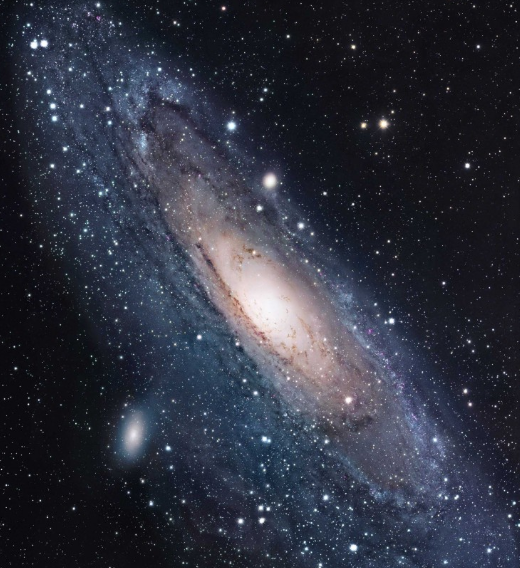
According to NASA, life is likely based on the size of our galaxy and the number of galaxies out in space. There have been thousands of exoplanets discovered with compositions similar to Earth’s, but still, life has not been found. According to former NASA astronaut Dr. Mae Jemison, “The reality is that we know that this universe, that our galaxy, has billions of stars. We know that stars have planets. So the likelihood that there is life somewhere else to me is just absolutely there.” However, the chances of life being created are incredibly low. Sir Fred Hoyle, a renowned astronomer, said the probability for the formation of the most basic of cells by natural processes is 1 in 1040,000(Institution of Creation Research). This number is compared to the chances of a tornado going through a junkyard and assembling a 747 airplane. Even if this very improbable event took place, another essential step, which is also highly unlikely, must take place, which is the cell evolving into a higher state. If this cell evolved, nothing would even happen because the cell must maintain equilibrium and eventually decay.
This age-old question still goes unanswered and most likely won’t be answered any time soon. Interstellar space travel has only been accomplished by Voyager 1, and intergalactic space travel is still thought to be impossible. As Albert Einstein said, “Everyone knew it was impossible, until a fool who didn’t know came along and did it.”