Freshly hit by the anxiety following the upcoming school year due to budget cuts, many Sam Barlow students are once again being slapped in the face by the returning anticipation and exhaustion that come with the Advanced Placement exams—just kidding, even though the tests are stressful. However, I think the long-term benefit outweighs the short-term stress, especially because they are a great way to save money for future college careers, when the last thing you’ll want to do is regret not taking a class you could have taken in high school for a maximum of $90, with opportunities for reduced fees. In this economy, they’re basically free. And even if you don’t pass the test, not to sound too conceited, but I think the true benefit lies in the challenge—in the way these courses offer a broader scope of knowledge that allows students to apply their critical thinking skills to other aspects of life. I think that many students prefer to take the easy way out when it comes to school, not that there’s anything wrong with that in itself, as education level is not a measure of value as a human being; however, students who do end up taking AP classes are usually the ones who prioritize their learning a bit more than others.
Sam Barlow currently offers 11 AP classes: AP Biology and AP Chemistry in the science department; AP Lang. & Comp., and AP Literature and Comp. in the writing department; AP Calculus A/B, AP Calculus B/C, and AP Statistics for math courses; and lastly, for social sciences: AP Human Geography, AP European History, AP US History, and AP Macroeconomics.
Beginning with AP Human Geography, this national exam was administered on Tuesday, May 5, at 8 a.m., and is offered to freshmen as a gateway for the other APs. It focuses on patterns of civilization and geography, emphasizing vocabulary and the application of models to the real world. The test includes 60 Multiple-Choice Questions (MCQs) and 3 Free-Response Questions (FRQs).
One APHuG student reports that the test went “okay,” with “easy” MCQs, and that she knew about half of the content in the FRQS. She predicts receiving a score of either 3 or 4 out of 5. This student states that the test environment was “strict,” with lots of “nit-picking about rules,” with students unable to bring their own pencils, have water at their tables, talk during the test, or close their Chromebooks. When the test ended, all she remembered feeling was “relief” and “pride.” As for the class overall, this student warns considering students that, “there is a lot of homework,” but the potential college credit makes it worth the struggle. She says that the teacher, Mr. Kirstein, is nice, and that many of the topics interest her.
This rigidity is standard for AP exams, and it’s important to note that this is only one student’s perspective– one who has never taken a national exam before. What this student may not realize is that the testing environment has to be strict to ensure fairness for all students taking this test, not just at Sam Barlow. Moreover, I think that the proctors often go unnoticed; to me, they all seemed very kind and devoted to reducing stress for frazzled students. I imagine it must also be incredibly boring to stand in complete silence for hours, making sure kids aren’t cheating.
Anyhow, exam month kicked off with AP Biology, its test starting exactly 24 hours before AP Human Geography’s. Taught by Mrs. Toptchian, “the test was basically a review of everything we learned the whole year; it was very concept-heavy,” according to one AP Bio student. “It included MCQs, SAQs, FRQs, and a lot of data to analyze and a graph to fill out. I think it went well, but yes, I was very stressed.” This student predicts to receive a score of 4. She advises other AP students to practice FRQs and SAQs, stating, “The limited time you have on the exam is rough,” so it’s important to make the most of that time by not getting stuck on how to phrase your writing, when you should be focused on the material you know. “I would recommend this to any student who is willing to put in the study time outside of school; there is such a heavy information load that you will quickly fall behind otherwise.”
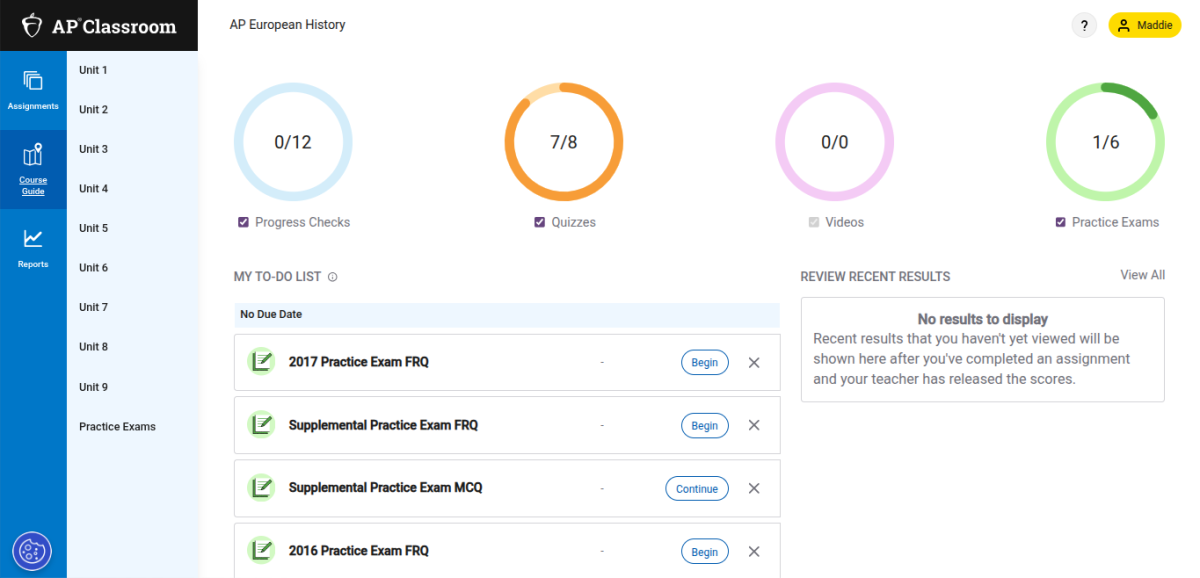
That Monday afternoon, at around 12:30, about 60 sophomores buckled down in their cushioned library chairs and began the four grueling hours of their AP European History Exam. This test is divided into two sections: 55 MCQs and three Short Answer Questions (SAQs) in the first half, along with a Document-Based Question (DBQ) and one Long Essay Question (LEQ). (All these acronyms, I know–kill it already.)
In between the sections, there was a ten-minute break that started automatically after the completion of the first section. During this break, students were allowed to get up and walk around, getting the chance to relieve some pressure from all that they had done, and from the anxiety of what was yet to come. In the writing sections of the test, the questions focused less on trivia and more on reasoning, which was fantastic for me because I started studying the morning of the test. The test ended at about 4:30, everyone staring expectantly at the proctors to be released to grab their bags and run as fast as they could out of that suffocating room.
For me, going into the test, I had expected not to do well, but in hindsight, although it was difficult, I think I did alright, and just as the APHuG student I interviewed feels, I’m so relieved it’s over. Of course, there’s always room for improvement, topics I could have studied more, practice tests I could have taken. Regardless, I gave it my best, and whatever score I get, I’ll be just glad I don’t have to take that test again.
AP Chemistry’s test was held at the same time as AP Human Geography’s, but was administered in a different room, not the library. This test included MCQs and FRQs that combine aspects of different units. Taught by Mr. Bridgenell, one AP Chem student reports that utilizing practice tests on the AP test site is crucial to truly understand the material and put it into practice. This student says that this class overall was very difficult, and is not for anyone who just wants to take an AP course; commitment is key. However, if you’re willing to put in the work and time, and you enjoy chemistry, this class might just be the science class you take next year!
Other AP test dates according to the official College Board website:
- AP Environmental Science– Friday, May 15, 2026, at 8 a.m.
- AP Lang. & Comp– Wednesday, May 13, 2026, at 8 a.m.
- AP Literature and Comp–Wednesday, May 6, 2026, at 8:00 a.m.
- AP Calculus A/B–Monday, May 11, 2026, at 8 a.m.
- AP Calculus B/C– Monday, May 11, 2026, at 8 a.m.
- AP Statistics– Thursday, May 7, 2026, at 12 p.m.
- AP US History–Friday, May 8, 2026, at 8 a.m.
- AP Macroeconomics– Friday, May 8, 2026, at 12 p.m.
Students can expect to receive their scores in early July. Good luck to the remaining test-takers! You’ve made it this far, so remember, all you can do is your best!